When to stop using a baby monitor
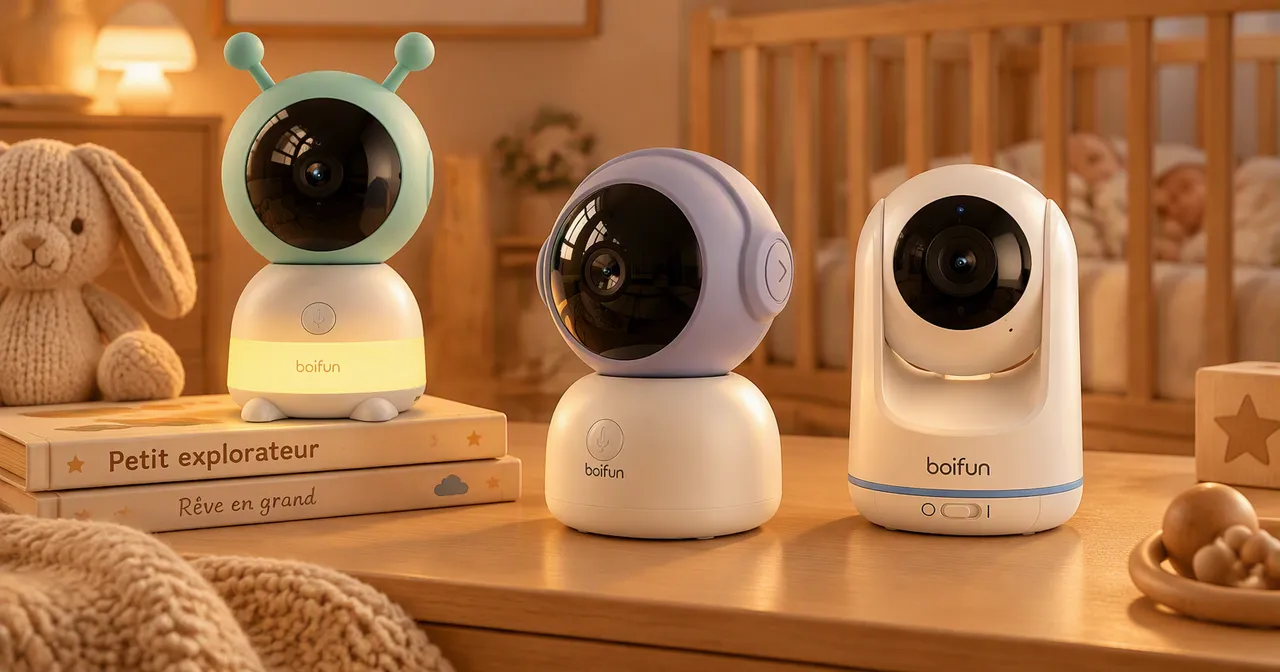
When to stop using a baby monitor? There is no single age. The sellers’ pages consulted for this site state no limit, and we found no official rule. This page offers common-sense markers for deciding: when to start, when to ease off, and when a camera stays useful or becomes unnecessary. It gives no medical advice.
When to start using a baby monitor
A baby monitor helps as soon as the child sleeps somewhere other than your room, or as soon as you move away for a task: kitchen, shower, yard. The pages consulted give no minimum age for the device. Questions about infant sleep (position, crib environment) belong to your doctor or pediatrician, not to a baby monitor.
The features listed on some models, such as the position or face-covered alerts of the Boifun Baby 4TM, are the seller’s arguments and do not replace an adult’s vigilance.
When to consider stopping
No date applies, but several situations change the picture:
- the child can call out, get up or come and find you alone;
- they sleep steadily, and you would hear a call from your room anyway;
- the layout of your home no longer justifies a continuous screen or sound;
- the child asks for privacy, which becomes more common as they grow.
Those markers are common sense, not thresholds based on data. Each family decides.
If the child sleeps in your bedroom
As long as the child sleeps in your bedroom, you hear them without a device: the baby monitor has no immediate use. It becomes useful when the crib changes room. It is reasonable to get the device a few weeks before the move, to get used to its settings without the pressure of difficult nights.
Phasing it out gradually
Stopping is not a switch. You can try a night or a nap without the device, with the door ajar, then notice what you hear from where you are. If the child falls asleep alone and you hear them well, the baby monitor adds little. If you still need it to feel at ease, nothing obliges you to do without: it is an aid, not a step to get past.
Keeping the camera longer
A camera can stay useful beyond early childhood: checking that a child has fallen asleep, or noticing a nightmare without going into the room. If you keep it, adapt the use. Turn it off during private moments, explain to the child what it does, and think about the security of the image, especially for a WiFi model (see baby monitor hacking).
Choosing a device that lasts
If you expect to use it for a long time, look at the battery life of the monitor, how easily the angle can be changed, and whether the model works without an app. Our guide on how to choose a baby monitor goes over these criteria, and the page on non WiFi baby monitors from Boifun presents models that are simple to use.
What this guide does not replace
A baby monitor is not a medical device and does not replace an adult being present. For any question about your child’s sleep or health, ask a health professional.
Frequently asked questions
Is there an official age to stop using a baby monitor?
The sellers’ pages consulted for this site give none, and we found no official rule. The moment is decided as a family, according to the child’s independence, the layout of your home and your own peace of mind.
From what age can you use a baby monitor?
From the moment the child sleeps in a different room from yours, or when you move away from the bedroom. The pages consulted give no minimum age for the device itself.
Can a baby monitor camera be used longer than an audio model?
Often yes, to check from a distance that a child is asleep or has woken up. As the child grows, privacy matters more: talk it over with them, and turn the camera off when it no longer has a reason to be on.